
Bulk Supply
Tariff
Methodology Statement
Executive Summary
This document provides an overview of the methods used to prepare the Bulk Supply Tariffs (BSTs) for electricity and water as they are applied to the Main Interconnected System (MIS) and Dhofar. Nama Power and Water Procurement (PWP) conducted a review of the BST methodology in 2011, which was approved by the Authority in February 2012.
2026 Update Note
The methodology used for the 2026 BSTs is unchanged in principle but introduces a Tariff Balancing Charge toward reducing year-to-year fluctuations in the tariffs that are not caused by changes in underlying costs in the current year. This change is intended to provide a clearer price signal to consumers.
Methodology Principles
1. Level
The level of both electricity and water BSTs should be set to the relevant revenue requirement. The revenue requirement is defined as the allowed financial costs allocated to the relevant sector and business.
2. Structure
The structure of the BSTs should be based on underlying marginal costs, and scaled appropriately to a level that will recover the revenue requirement. Conclusions specific to the electricity and water sectors are described as follows:
The structure is based on underlying short-run marginal economic costs. This approach best promotes allocative efficiency, recognising that electricity consumption outside the peak demand periods is unlikely to require new capacity. Both short-run marginal capacity costs and short-run marginal energy costs are scaled by a common factor to reach the electricity revenue requirement, in order to preserve the price signal.
The structure is based on long-run marginal economic costs. Considering that incremental water demand at any time of the year requires new capacity, unlike electricity, this approach best promotes allocative efficiency in the water sector. Separate scaling factors are determined for the fixed and variable components: the fixed component of long-run marginal costs are scaled to reach the fixed component of the water revenue requirement, and the variable component of long-run marginal costs are scaled separately to recover the variable component of the water revenue requirement. Other scaling approaches would expose PWP to potentially large mismatches between its revenues and its costs given the difficulties with forecasting water sales volumes, and the large difference between variable economic cost and variable financial costs faced by PWP.
3. Billing Determinants
The current billing determinants remain appropriate for both electricity and water.
Introduction
This document summarises the key steps in the methodology used to develop the electricity and water BSTs for 2026. The description of these steps examines first the electricity BST methodology, then the water BST methodology, and finally, the allocation of joint costs (in the case of IPWPs) to the electricity and water sectors respectively. The electricity BST for 2026 are presented in annex to the document.
Guiding Principles
A. Financial Costs Basis
Tariff levels should be based on financial costs*. While efficiency arguments would suggest tariff levels should be based on the economic costs, this is considered unacceptable as it would result in a large over-recovery of financial costs (i.e., exceeding the Maximum Allowed Revenue in the PWP licence).
B. Economic Marginal Structure
Tariff structure should be based on the underlying structure of marginal costs. Economic efficiency will be encouraged by reflecting the underlying structure of marginal costs where reasonably practical, for example in the choice of rate bands for electricity.
Models Framework
Demand Forecast Models
An in-house Excel models that take input on historical GDP, electricity and water demand, and projections of customer load growth to develop a forecast of electricity and water demand, which is used as input to the Power System Simulation model.
Power System Simulation Model
A proprietary generation investment planning and dispatch model, that takes input data on demand, generation and fuel prices (in either economic or financial prices), and power system operational characteristics to simulate the hourly dispatch of the power system and simultaneously estimate hourly short-run marginal costs (SRMCs), disaggregated into short-run marginal capacity costs (SRMCCs) and short-run marginal energy costs (SRMECS), and fuel costs.
Revenue Requirements Model
An in-house Excel model that takes input data on PWP purchase costs, PWP-own costs and other allowed costs and derives revenue to be recovered from the electricity and water BSTs for the Main Interconnected System ("MIS") and the Dhofar Power System ("DPS") (previously known as the Salalah System).
Electricity BST Model
An in-house Excel model that takes input data on hourly SRMCCs and SRMECS from the Power System Simulation model and the electricity revenue requirement from the Revenue Requirements model together with a user selection of rate bands and scaling approach to derive the electricity BST for a particular system.
Water BST Model
An in-house Excel model that takes input data on costs of water production from a recent engineering report, electricity costs from the electricity BST model and the water revenue requirement from the Revenue Requirements model together with a user selection of scaling approach to derive the water BST for a particular system.
The models place certain practical limitations on the methodologies. The Power System Simulation model is an hourly unit-commitment model that meets international standards, yet its flexibility is also somewhat limited as it needs significant user inputs to model combinations of outages of equipment at the combined cycle plants and electricity production at IWPPs and to meet the security standard in terms of loss-of-load-hours (LOLH). The in-house models were also developed to provide flexibility, yet there are implicit limitations in their design as well as explicit limitations such as on the number of rate bands, choice of hours in each rate band and the selection of scaling approach.
Electricity BST Methodology
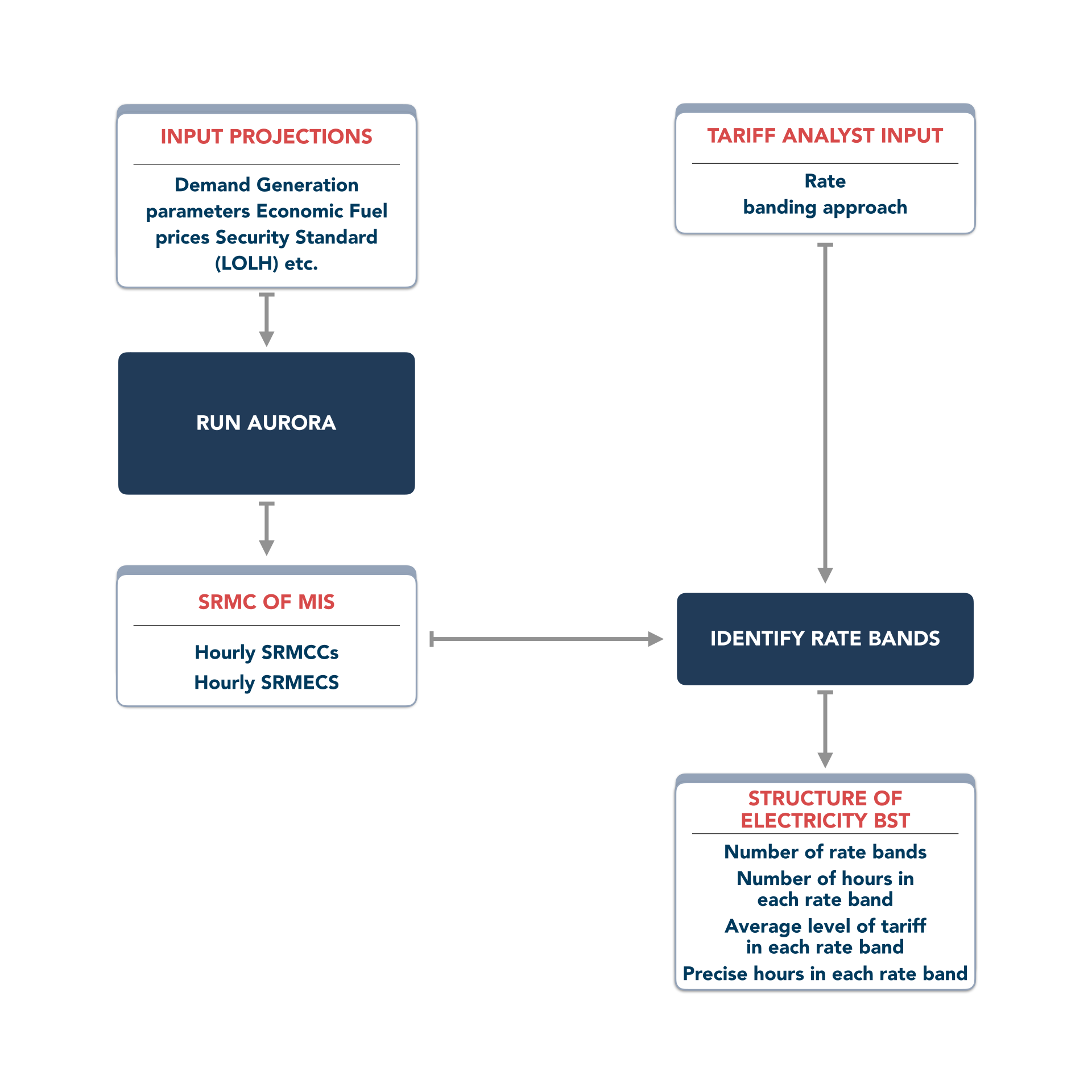
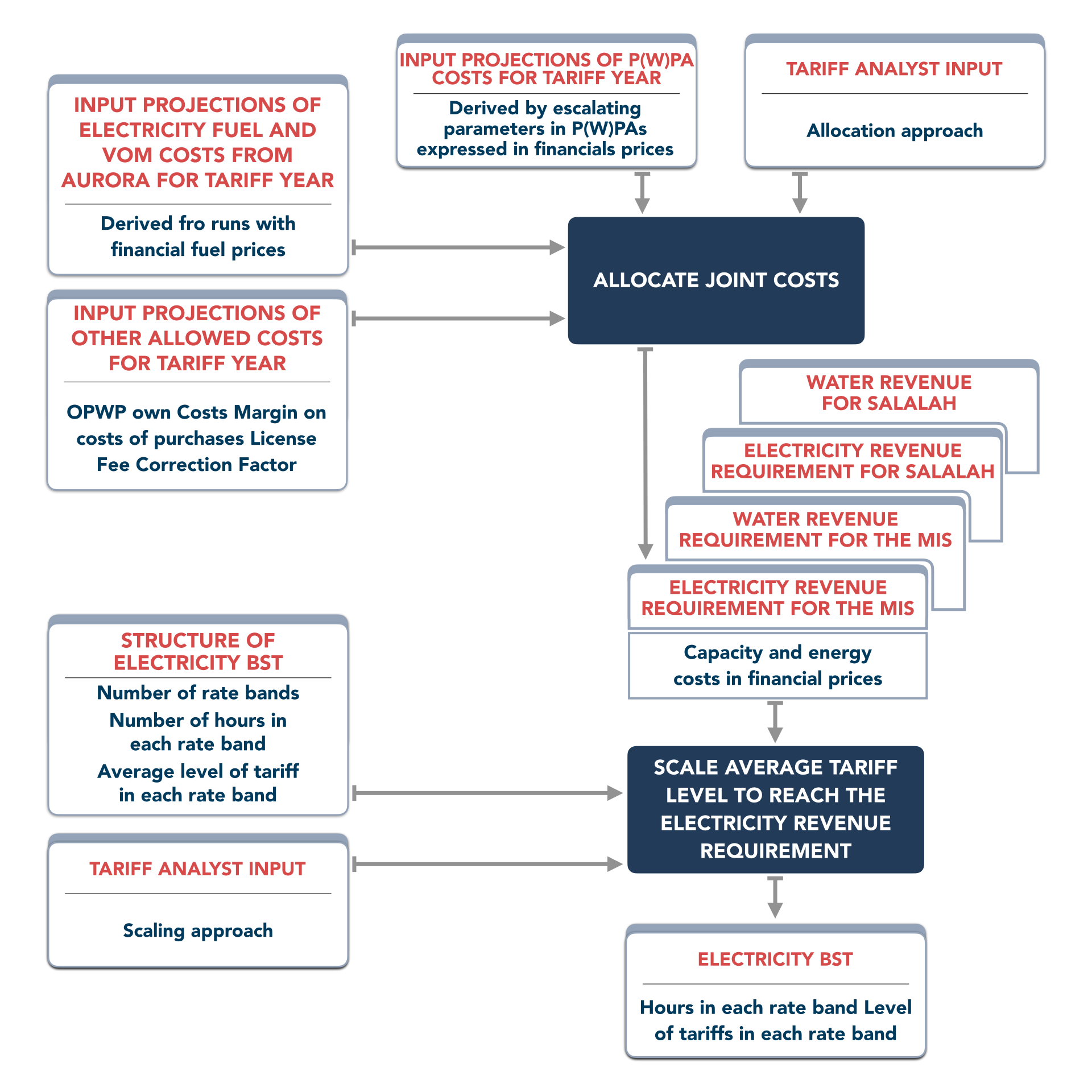
The principles used to develop the electricity BST and the key steps in the methodology are described below, dealing firstly with structure and secondly with level and scaling. Figures 1 and 2 show the main steps in the development of the electricity BST.
Principles
The following five principles have guided the development of the electricity BST:
(a) Structure
The structure of the BST is set to reflect short run marginal economic costs in order to promote allocative efficiency.
(b) Level
The level of the BST is set to achieve the combined electricity revenue requirement of the MIS and DPS. This revenue requirement comprises the financial costs attributed to electricity, comprising:
(c) Scaling
Tariffs are scaled to reflect short-run marginal economic costs. The scaling factor is determined to limit total revenues to the electricity revenue requirement. The scaling factor is multiplicative, and applies uniformly to both capacity and energy costs for the following reasons:
(d) Joint Costs
The allocation of joint costs at IWPPs between electricity and water is based on sharing the benefits of joint production.
(e) Billing
The current billing determinant remains appropriate. This is a single variable charge expressed in RO/MWh that combines both capacity and energy components (and, thus, ensures that variable charges better reflect underlying economic costs than would be the case if separate fixed and variable charges were introduced).
Tariff Structure
Concerning tariff structure, and specifically the rate bands, the methodology comprises the following steps:
Establish Input Data
Establish input data to the Power System Simulation model. The input data include projected demand (provided by the Demand Forecast models), operating and cost characteristics of generation units, projected fuel prices and value of lost load (VOLL) at economic prices, and unit operating constraints such as must-run generation and outages of equipment at the combined cycle plants and IWPPs*.
Run Power System Simulation
Run the Power System Simulation model for many iterations with stochastic demand and plant availability to determine the hourly average SRMCS, SRMCCs and SRMECs for a system in which plant capacity has been manually adjusted to ensure generation adequacy according to required standards**. For a particular iteration and hour, there is either:
Identify Rate Bands
Identify rate bands for each of the MIS and DPS by examining the hourly profile of average SRMCs and manually grouping the profile into bands of hours having similar SRMCS.
Determine Tariff Levels
Determine tariff levels separately for each of the MIS and DPS, separated into capacity and energy components, for the selected rate bands as the demand-weighted average of the SRMCs for each hour in the relevant rate band.
Level and Scaling
Concerning the level and scaling of the tariffs, the methodology comprises the following steps:
Establish Purchase Costs
Establish the purchase costs of electricity. These are the expected costs for the tariff year, projected according to the P(W)PA terms for each plant. They include the following components:
Establish Other Allowed Costs
Establish other allowed costs for the tariff year, comprising the projected amounts for:
Allocate Financial Costs
Allocate financial costs to electricity and water for both the MIS and DPS, as set out more fully below, to determine the respective revenue requirements and their separation into fixed and variable components (with respect to output).
Scale SRMC-based Levels
Scale the SRMC-based tariff levels to the electricity revenue requirement using the following procedure:
* Of necessity, given the complex configurations of steam turbines, gas turbines, heat recovery steam generators and auxiliary boilers that can be in service at the IWPPs, we make a number simplifications.
** The current generation security standard requires that there should be no more than 24 LOLH each year; whereas the GCC interconnection standard requires no more than 5 LOLH each year for the interconnected system. For BST purposes only, we have chosen to use around 5 LOLH to determine the SRMC profile. Using fewer LOLH to determine the SRMCs tends to mean sharper peaks in the SRMC profile as the times of loss of load, and hence material system stress and material SRMCCs, become confined to fewer hours.
Water BST Methodology
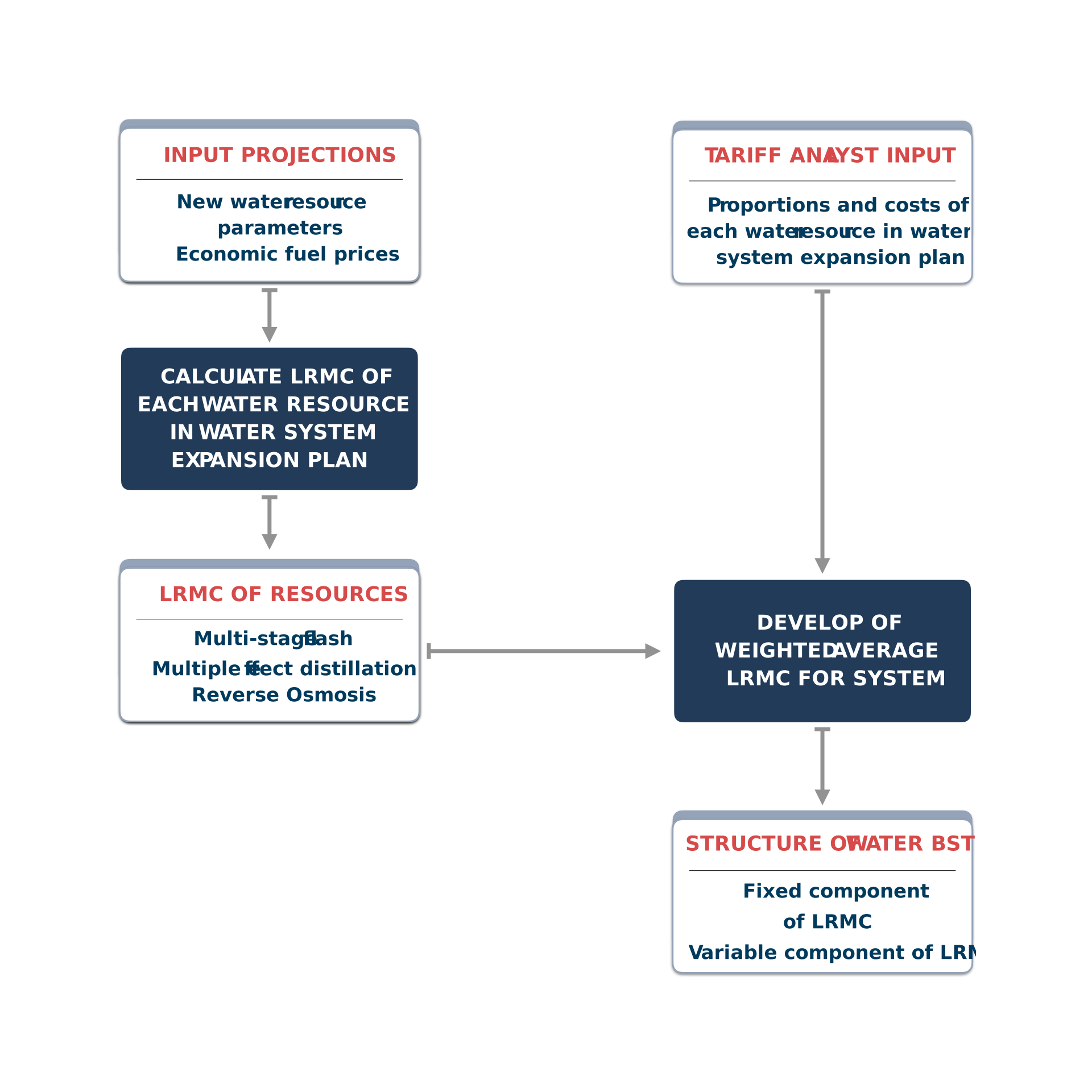
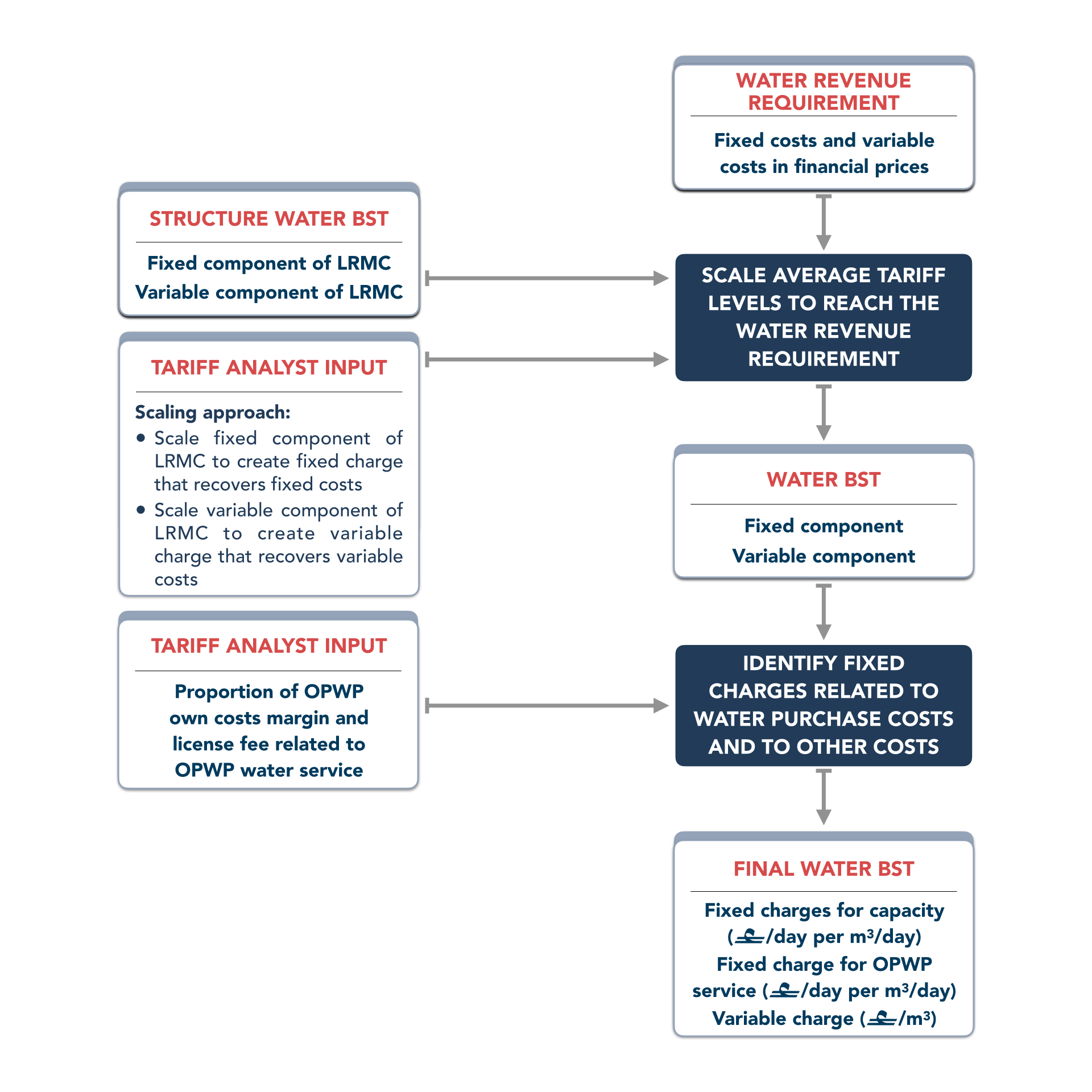
The principles used to develop the water BST are described below, followed by the key steps in the methodology dealing firstly with structure and secondly with level and scaling. Figures 3 and 4 show the main steps in the development of the water BST.
Principles
As for electricity, a key design choice is between structures that reflect SRMCs and structures that reflect long-run marginal costs (LRMCs). However, the choice is complicated by:
- (a) absence of a suitable "water dispatch" model to determine SRMCs or LRMCs; and
- (b) availability of substitute water resources that may not be priced at marginal economic costs.
Key Exceptions from Electricity Methodology
The structure of the BST is based on the long run marginal economic costs, as there is little spare capacity at existing water production facilities, which means that incremental demand will require development of new capacity.
The fixed and variable components of the tariff are scaled by separate multiplicative factors, to recover respectively the fixed component and the variable component of the water revenue requirement.
Accordingly, the water BST methodology adheres to the following principles:
(a) Structure
The structure of the BST is set to reflect long run marginal economic costs.
(b) Level
The level of the BST is set to achieve the water revenue requirement. This revenue requirement comprises the financial costs attributed to water, comprising:
(c) Scaling
Separate multiplicative factors are used to scale the fixed and variable components of the tariff. Separate factors are used rather than a uniform factor (as in the electricity BST methodology) for the following reasons:
(d) Joint Costs
The allocation of joint costs at IWPPs between electricity and water is based on sharing the benefits of joint production.
(e) Billing
The current billing determinants remain appropriate. These comprise
Structure
Concerning structure, the methodology comprises the following four steps:
Establish Input Data
Establish input data required to estimate LRMCs and projected actual costs of water production for the principal water resources. These inputs include projected technology capital and FOM costs, economic lifetimes, fuel prices, and VOM costs at economic prices. LRMCS are projected to be those associated with new RO technology, benchmarked to the most recent tariffs arising out of PWP competitive tenders for IWPs. With respect to assessing the cost of water production under joint production at co-generation plants, the methodology is described in a subsequent section below, Allocation of Joint Costs to Electricity and Water. In principle, we assume for these plants that (i) the electricity sector bears the costs that it would have incurred if electricity were produced on a stand-alone CCGT, and (ii) the water sector bears all other costs associated with joint production.*
Determine LRMC
Determine the LRMC of each new water resource using the input data.
Establish Input Proportions
Establish input proportions of water production on each new water resources**. In the absence of better information, for 2022 BST purposes, we assume that all new water production will be by RO plant in all zones of the MIS and Dhofar. The variable costs of RO plants are time differentiated-varying by time of day and season of the year- reflecting the impact of time-differentiated electricity costs (as seen in the electricity BST).
Average LRMC
Determine the fixed and variable components of the average LRMC by taking a weighted average of the fixed and variable costs of the various technologies.
Level and Scaling
Concerning the tariff level and scaling, the methodology comprises the following four key steps:
Identify Revenue Requirement
Take the fixed and variable components of the water revenue requirement (established as described under the electricity BST).
Separate Scaling
Scale each of the fixed and variable components of the LRMC-based tariffs by a separate multiplicative factor to obtain, respectively, the fixed and variable components of the water revenue requirement.
Identify Fixed Charges
Identify the proportion of fixed charges that recovers the water purchase costs and the other costs allocated to water. This step relies on a historical analysis of the proportions of PWP-own costs that relate to the water sector.
Establish Final BST
Establish the final water BST with three billing determinants:
The fixed charges for capacity and fixed charges for the PWP service are listed separately, because the availability rebate applies to fixed charges for capacity only.
* See for example "Energy and Cost Allocation in Dual Purpose Power and Desalination Plants", by N M Wade, WSTA/EDS workshop on privatization in water supply, Bahrain, February 1999 referenced in PWP report "Salalah new generating capacity strategy" dated 2011.
** If cost were the only consideration, PWP's 2011 report "Salalah new generating capacity strategy" suggests that, for gas prices above about 1.0 USD/MMBTU, reverse osmosis (RO) has lower total costs than either multi-effect distillation (MED) under joint production or multi-stage flash distillation (MSF) under joint production and, hence, all new water production would be from reverse osmosis plants. However, for a number of reasons, security of supply considerations may suggest that new water production should be from a range of technologies. This remains a potential issue for further study.
Allocation of Joint Costs
The following approach has been adopted to allocate the joint costs of production purchased from IWPPs:
Determine Total Cost
Determine the total cost for expected electricity and expected water production at each I(W)PP, separated into fixed and variable components. For example, the total purchase costs in respect of an electricity-only plant (e.g., Manah) is calculated from the PPA parameters and from the Power System Simulation model, by summing:
- a. Fuel and VOM costs from the Power System Simulation model;
- b. Capital and FOM costs from the PPA; and
- c. Other costs from the PPA, such as the annual generation licence fee and connection fee (expressed on a monthly basis rather than annually)*.
Allocate Direct Costs
Allocate direct costs as follows:
The costs of IPPs and any separately identified costs of stand-alone electricity facilities at the IWPPs;
Any separately identified costs of any stand-alone water facilities at the IWPPs.
Allocate Joint Costs at IWPPs
Allocate joint costs at IWPPs as follows:
- a. Determine the stand-alone costs for expected electricity and expected water production at the time the plant was conceived. In this regard, stand-alone electricity production is based on a gas-fired CCGT in all cases.**
- b. Allocate the joint cost for expected electricity and expected water production under the PWPA to electricity and water in proportion to the relevant stand-alone costs of electricity and water (equivalent to allocating the cost savings from joint production to electricity and water in proportion to the respective stand-alone costs***).
Allocation of Other Allowed Costs
PWP-own Costs
Allocated based on historical estimates of the proportions of PWP staff time inputs that relate to the various activities.
0.25% Margin
On purchase costs is allocated to electricity and water in proportion to the respective purchase costs including allocated joint costs.****
Licence Fee
Is also allocated to electricity and water in proportion to the respective purchase costs.
Includes adjustments to be made to the tariff rates based on the K-Factor, the difference between the Maximum Allowed Revenue and the Proposed Revenue, and Liquidated Damages (if any).
* Changes in licence fees and connection fees are recoverable under "change of law" provisions in the PPA. Any other costs recoverable as a result of the "change in law" provisions of the PPA would also be included here.
** PWP uses the stand-alone CCGT and stand-alone RO plants set out in the Mott MacDonald analysis conducted for Salalah IWPP in 2011.
*** Economic theory provides no definitive allocation of joint costs. Instead, economic theory merely provides a ceiling and a floor to the allocation: the ceiling is set by the stand alone cost of production; and the floor is set by the incremental cost under joint production.
**** Steps a) and b) are done indirectly by levying a service charge on water capacity which is deemed to represent an appropriate share of cost and margin.